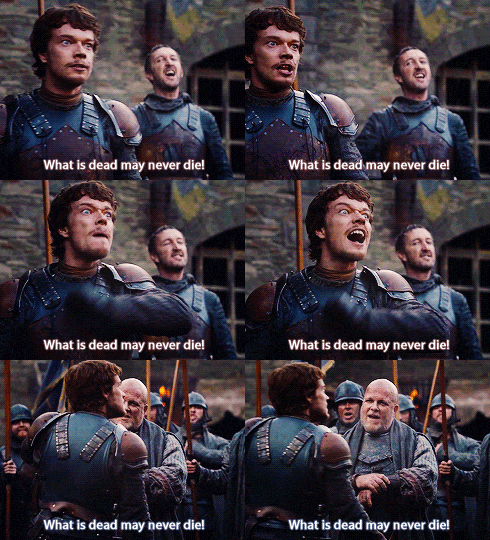
Excerpt: A quick overview of why Arya killing the Night King was never going to work – and the characters who could have made it work.

Introduction: Yes, I’m still salty about this…
i.e. Why Arya shouldn’t have killed the Night King.
After the killing of the Night King, the reaction most people had to what happened was: “I don’t mind that Arya killed the Night King but it didn’t feel earned.” Heck, I’m sure even I said it at least once. It was only a little while later I was able to come to terms with the fact that I was lying. What was that “Ned-ism”? That pearl of wisdom Eddard Stark gave his little brother and sons?
“Anything a person says before the word ‘but’ doesn’t count.”
Moreover, I don’t think I’m the only one: people who say that, by definition, *do* mind that Arya killed the Night King. Yes, we might then try to backpaddle and try to say that had there been more “build-up” it might have worked — but that’s the point. We dislike it because Arya was inserted into a plotline to which she didn’t belong. Once you get over the initial shock, it becomes a glaring issue almost impossible to ignore.
It was a poor writing choice and god knows what was going through Dumb and Dumber’s heads three years ago, approximately when they sat down to write the abortion that was season 7, to force Arya into this slot.
There’s a reason why the people who “pay attention” – as opposed to drunken morons in a bar watching the show – hesitantly added the prefix “I don’t mind she did it…” before the word “but” and I feel it has a lot to do with the reluctance to say anything bad about Arya even, as a character, she has been nothing short of terrible since season 4. In terms of the plot, really, what would have been lost if she had just been… killed by the Waif in season 6? There were no consequences for her killing the Freys, she span her wheels in Winterfell for a season and half, and then sailed away with no true goal. If one were to be cynical, one would argue that the reason they got Arya to kill the Night King was to, literally, give her something to do. To justify her still even being there.
Here is a list of top five other characters who it would have made more sense to have killed the Night King.
The List
i.e. Five Characters Who Could Have Killed the Night King and It Would Have Made More Sense.
Including gifs and pictures to illustrate the point, I decided to compile a list of five figures within the story who would have made for a worthier slayer of the so-called “god of Death”: a name that even now makes no sense given that the Night King’s power revolves around turning dead humans into wights (i.e. undead things) and living infant humans into other white walkers.
Incidentally, they are not ranked per se. I have started with the most obvious candidate *hint* the one we all thought would kill the Night King *hint* and ending with the ones who I feel had the most groundwork to succeed in the kill though not necessarily obvious by any means.
The aim of this is to demonstrate that – even after having two years to stew on this – David Benioff and D. B. Weiss’s desire for a subversive candidate cheapened what could have been a more satisfying kill than “stupid-flying-Arya”.
5. Samwell Tarly, The Unlikely
Samwell Tarly, “The Killer”
Slayer of men, lover of women, the first person to kill a white walker in thousands of years. One might look at this and think, “Are you serious? Sam would have been a better choice than Arya?!” Yes, I am deadly serious.
5. Jaime Lannister, The King(s?)slayer

Honestly, I felt like I had to include him in this list.
Of all the characters that I have considered for this list, he was the last one I added and probably the one with the least narrative reason to be “The One” purely because he is not tied to the White Walker plot.
In the books, who knows where his story will take him? He has long since broken away from Cersei and is currently on his way to Lady Stoneheart — whether she will just kill him or force him to perform some tasks for him is a debate for another time. In the show, they kept him in King’s Landing and with Cersei for far, far too long seemingly for no other reason than to give Cersei someone to talk to. And heaven forbid they actually let her having meaningful interactions with Qyburn or Euron. Much like with Arya, having him suddenly have this interest in killing the mythical leader of the White Walkers would have felt jarring.
Nonetheless, he does have a connection to another character who themselves is tied into the White Walker plot and is the target of the Night King. Indeed, you have probably been muttering this at your screen as you read the last paragraph.

Oh yes! Jaime does at least have this: shoving a sweet, baby-faced Bran out of a window.
For viewers and readers alike this sealed Jaime’s place as the ultimate douchbag evil guy who deserved punishment for his crime. He did get this, of course. He lost his sword-hand, and thus perceived his identity, leading him through a severe crisis of self – one which he is barely brought back from through his budding friendship and comradery with young Brienne of Tarth. With no swordhand, he is forced to look upon his empty pages in the White Book, in which the noble deeds of the Kingsguard are recorded, and consider how else he is going to be remembered.
Yet it is hard to get this “original sin” out of our minds. Not least because Jaime himself largely does not think about this action despite the fact that his reasons for doing so were centred entirely around Cersei and what he thought she would want him to do. Something he was wrong about. Cersei just wanted to scare him; Jaime’s first instinct was to try and help pull Bran up. It was an awful spur of the moment choice yet it had lasting consequences for Bran, which took away something which he deeply valued. Losing his hand was very much Jaime’s “window-pushing” moment — and it is worth noting that in the show, Bran was also the one to avenge the action by killing Locke.
In an odd way, Bran and Jaime have been intrinstically tied to each other — and their reunion in S8 was widely anticipated albeit incredibly underwhelming and predictable.
3. Meera Reed, The Loyalist
Yeah, GirlBoss!
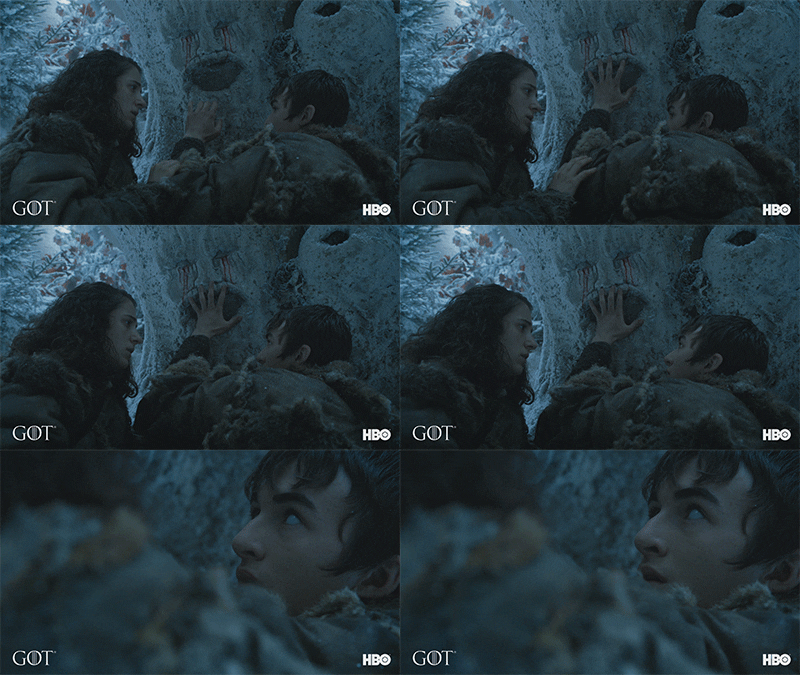
All rise for our queen, everyone!
She is argubly the most underrated and underappreciated character in the whole of Game of Thrones. From her introduction the show provided us with her “character defining” line all but immediately to let us know the sort of person she is. Some people will always need help but that doesn’t mean they aren’t worth helping. The compassionate maiden daughter of Lord Howland Reed of Greywater Watch or makes nearly every other character pale in the might of her selflessness and consideration for other people.
If Jon’s right to slay the Night Night comes from his connection to the white walker plot and Theon’s comes from his connection to Bran’s story arc, then Meera’s right stems from both.
Truth be told… I find it all very suspicious.
To the point where I wonder if, perhaps, in D&D’s attempts at “streamlining” things they didn’t rip-off the Arya kill off what might have originally been something Meera was supposed to do, based off a plot bullet point from GRRM. As I said, I don’t believe there is a Night King in the books – and if he is in the books, he’s unlikely to be called the “Night King” as GRRM – but there could very well be leaders (plural) among the Others and I believe one of them might well try to go after Bran. We will see.
Still, even within the context of the show I have to ask – who have we categorically seen perform these sorts of sneak attacks? Crannogmen. No assassin training, just plain old stealth.
2. Theon Greyjoy, The Anti-Jon

I’ve written the most for this one because… Theon was ROBBED!!!
One cannot make a list such as this without including the Prince of the Iron Islands himself, Theon Greyjoy. He is the kinslayer, turncloak and Reek. He is also the redeemed – and argubly the character who suffered the hardest consequences for his actions. Some might call it justice but given everything that Ramsay did to him, robbing him of his very identity, some might say it was too much. George R. R. Martin has essentially confirmed that Theon is in many ways Jon Snow’s foil. The “Anti-Jon” of the story. Many people reading might aspire to be Jon but in reality they are more likely to be Theon.
While not tied to the white walker battle, his journey to redemption is very much tied to Bran Stark, the man who the Night King and the other walkers supposedly wish to kill the most. Perhaps the biggest irony of the episode where the Night King was felled was that Benioff and Weiss were so close to a perfect death for both Theon and the Night King — yet threw it away on the stupid, story-breaking Arya kill.
Theon Greyjoy begins the story as a ward of Lord Eddard Stark of Winterfell and foster sibling to the Starks and Jon Snow. A rather haughty and entitled lad, he teeters on the edge of fantasing about his potential future as the Lord Reaper of Pyke and ruler of the Iron Islands, and his desire to be accepted by his foster family. He is good friends with Robb and in the show especially seems utterly sincere in his love for him as a brother. Whenever anyone reminds him that he came to Winterfell as a prisoner and is not a Stark, it touches a very deep nerve in Theon. Together, this makes his ultimate betrayal of the Starks in season 2 and A Clash of Kings a bitter pill to swallow – yet oddly understandable considering the lack of stability Theon feels with his identity. Is he Ironborn or Stark?
While some might argue that Robb was the character who Theon betrayed the most, due to their friendship and brotherhood, the person who he “harmed” the most was little Bran.

With Bran as the sitting Lord of Winterfell, Theon’s choice to invade the North for his father and then break away from the intial plan to take Winterfell in a bid to prove himself is an attack not just on the people who called him family for ten years but hurt a little boy who had had always known him to be a friend. Bran was born the year of the Greyjoy Rebellion and thus is probably one of the people who genuinely always looked upon Theon as a brother figure. Worse still, upon taking Winterfell from Bran Theon plays on Bran’s benevolence to coherse him into yielding the castle. Bran’s first instinct is one of anger, to never yield, fight back and force Theon out. It is only when Theon sits down and speaks to him almost in the fraternal, caring manner than Bran complies. A good lord would yield to keep his people safe… and Bran is a good (albeit young) lord. This was an interesting choice for the show as, in the books, it is Luwin who ultimately tells him there is no shame in yielding to protect his people. In the show, they wished to really play up the twisted nature of the broken-down, brotherly bond that we were led to presume existed between Bran and Theon. Worse still, Theon very quickly reneges on his word to Bran that no harm would come to his people if he yielded. In the books, he has Mikken the Blacksmith killed; in the show, he kills Ser Rodrik personally.
It is the taking of Winterfell that leads to Theon’s swift downfall there, too. He doesn’t have enough men to hold the castle and very quickly loses Bran and Rickon as hostages. In a desperate bid to rule through fear, having failed to incite loyalty through any other means, he murders two millers boys – in the books, one is even implied to have been Theon’s bastard – and passes them off as Bran and Rickon to the rest of the world. Finally, when Yara (Asha) tries to convince him to withdraw from Winterfell and come with her before the North are able to gather their men and besige him, he refuses – preparing to die on the hill of his own mistakes.
He gives one last rousing speech to his men, preparing to committ suicide by cop — or Northern host…

It back fires. When Roose Bolton’s men, led by Ramsay Snow, arrive at the gates – they trick the Ironborn into handing over Theon before prompting sacking the castle. He is bundled off to the Dreadfort, leaving Bran and his crew to emerge from their hiding place in the crypts to discover the destruction. Thereafter, he becomes the play thing of Ramsay Snow, later gaining legitimisation as a Bolton, and is tortured and tormented beyond conprehension until he can only see himself as “Reek”. Even when Yara takes her twenty good men to try and rescue Theon from Ramsay, she is disturbed to find that her brother has been so mentally broken that he is as good as dead.
From beginning to end, Theon Greyjoy’s story was about identity. Greyjoy or Stark? Ironborn or Northerner? Theon or Reek? Once more it is interwoven with a tale of redemption.
In his desperation to be accepted by someone, he ultimately is rejected by everyone. He ultimately begins his road to redemption through Sansa Stark (The Jeyne Poole of the show) as her pleas for him to remember who he is finally breakthrough to him and he helps her escape from her abusive marriage to Ramsay, allowing her to ultimately be take to Jon at the Wall by Brienne. After this, he reunites with his sister and supports her claim as Queen of the Iron Islands, then following her to the Bay of Dragons (i.e. Slayers Bay) to treat with Daenerys and offer her their fleet in return for her support after Euron wins the Kingsmoot. Then, he makes peace with Jon — the closest thing he can get to making peace with Robb and Ned — who assures him that he doesn’t have to choose between his Greyjoy-roots and his Stark-upbringing. It is his affirmation that inspires Theon to rescue Yara from their uncle after he had previously fled in terror.
Then finally, he returns to Winterfell for the first time since escaping Ramsay to pledge himself to the Starks and offer his bow to defend Bran in the War for the Dawn. His path of making amends for each misdeed he ever made brings him back the the first — taking Winterfell from Bran Stark.

Yes, yes, Bran is technically “Bran-tron” now but the fact remains that from Theon’s perspective, this is the best way he knows how to try and make amends for everything he did to him. A competent writer might have looked at that and thought, “…and won’t it be satisfying if the anti-hero, the anti-villain, the Jon Snow foil, slays the Night King instead of Jon Snow himself?!”
Alas, David and Dan were so close yet utterly tripped and missed the finish line.
As already stated, the circumstances for Theon being the one to kill the Night King were set-up to perfection that it seems like a break in logic that it never occurred to Benioff and Weiss not to have Theon be the one to do it.
It wouldn’t have even take much of a change in the overall set up to make it work. Theon was right there in the godswood with Bran and was the sole surviving human on-location with him who could have defended him if Jon Snow failed to reach him. Instead of doing that stupid death charge that really didn’t achieve anything and only led to Theon dying, thinking that he failed, he could have instead stayed firm and resolute as the Night King approaches him and Bran. He can try to attack him once he’s in range, only to stabbed by with the ice sword and thrown to the ground.
Then, just as he is about to take a swing at Bran, Theon is able to struggle up for one. last. go.
Heck, if you really wanted to play off the Jon/Theon parallel, then have Jon make it to the godswood and thrown to one-side. As stated earlier, the Night King seems to enjoy taunting the humans around him and thus might wish to show this pesky human leader that eveything he tried to do was all for nothing — he will watch his little brother die before being killed himself. Only then Theon grabs Longclaw, or a dragonglass dagger, rushes the Night King to save his “little brother” too. The Night King will stab his sword into him… but so will Theon, using the last of his strength to rip it upwards and dislodging the dragonglass in his heart.
Of all the choices on this list, if it wasn’t going to be Jon – or the people canonically present in the show, in that episode, at that time – no one will ever convince me otherwise that Theon was the best choice to do the deed.
It would have provided a “dramatically satisfying” end to Theon’s arc; he was in the godwood with Bran and would not have had to jump out of nowhere to attack the Night King; his choice to stand and fight for Bran was motivated by his guilt for having hurt him, his little foster brother, so much; and because of that choice he lost his life. In the show, he essentially dies a failure. In this scenerio, he demonstrates that even the worst acts imaginable can be redeemed.
1. Jon Snow, The Prime Candidate

Jon Snow
The Bastard of Winterfell;
998th Lord Commander of the Night’s Watch;
The man who took a knife through the heart and lived again;
The Rightful King of the Iron Throne and Protector of the Seven Kingdoms;
The White Wolf!
The King in the North!
DUH!
If you wanted “dramatically satisfying”, then Jon was the man for the job. Yet the whole reason why D&D didn’t want it to be Jon who killed the Night King is because it “didn’t feel right” – presumably because they thought it was too obvious. The result was throwing years of plot development out the window.
Jon Snow has been intrinsically linked to the magic beyond the Wall and the white walker plot from the very beginning. He has often acted as the audience’s eyes for each discovery about the white walkers and ultimately became the figure who took it upon himself to ready the Night’s Watch, then the North and the rest of Westeros, against the oncoming threat.
As the Bastard of Winterfell, he could never hope to hold any lands or titles like his three brothers – so, he opted to join the Night’s Watch like his Uncle Benjen in the hopes that there he might find honour. What he finds is a group of ill-trained commoners and criminals with far more tragic stories than them. He eventually learns to befriend them by assisting them in their combat training and is ultimately hand-picked by Jeor Mormont to be his personal stewart in order to groom him as a potential successor.
Upon his first journey beyond the Wall, to take his vows before the heart tree, his direwolf Ghost discovers the bodies of two of his lost uncle’s ranging party – with no sign of Benjen himself. Then, he saves his master from one of the said ranging party when he rises again as a wight, earning him the rewarded of Longclaw, the Valyrian steel sword of House Mormont. His vows are tested when his beloved brother Robb Stark marches to battle against the Lannisters to try and save their father after he is arrested for attempting his coup in King’s Landing but is ultimately convinced to stay by Samwell, Grenn and Pip. With his return, Jeor announces that he intents to discover what is going on beyond the Wall himself with a great ranging, to discover what happened to Benjen Stark – whether he is dead or alive. He asks Jon Snow whether he is a boy playing at war or a man of the Night’s Watch. Acknowledging the threat beyond the Wall trumps anything Robb might be facing, he journeys into the unknown with the other rangers and deeper into the white walker plot.
It is through Jon’s eyes we learn the white walkers take child-sacrifices from wildlings such as Craster; he becomes our “mole” into the inner workings of the Free Folk; he returns to the Night’s Watch and assists in the command of the defence of Castle Black; and it is ultimately he who treats with Mance Rayder in a bid to end the assault on the Wall. He falls in love with Ygritte yet is forced to watch her die as they end up on different sides of the battle; he becomes the new Lord Commander of the Night’s Watch; earns the trust of Tormund Giantsbane, one of the more respected wildling leaders, and together they lead a rescue attempt on the largest settlement beyond the Wall – Hardhome.
It is here that Jon’s position as the white walkers’ biggest human adversary should have been sealed. Of all the human characters, Jon Snow is arguably one of the only characters to have what could be called a “confrontation with the Night King. He’s one of the few human characters who the the leader of the white walkers could pick out of a crowd and it’s not because of some magical force that attracts him to him but simply because Jon Snow was one of the few humans to openly attempt to take action against him, to stop him from taking more humans for his army.
Ultimately, D&D’s belief that it didn’t feel “right” for Jon to take out the Night King was a rather odd statement. Perhaps they felt he was too close to the story? But that is exactly the point. Jon Snow for a long time was just one of many in an ensemble cast of characters. Yet as they began to place more and more focus on action scenes with Jon as the feature figure, whether against Ramsay Bolton or the Night King, the more they probably tricked themselves into believing that Jon Snow killing the Night King would be too obvious — as he has been the centre piece of every single penultimate episode battle since season 4.
Yet there are other ways they could have felled the Night King with Jon and made it less obvious. The fans were mainly expecting a massive sword fight with the Great Other; instead, they could have used a trickster method to do the deed in the end and it would have felt more satisfying for an audience who have been watching closely over the last eight years.
The set-up for Jon being the one to destroy the Night King in ‘The Long Night’ would have been less convoluted than what we got. For one thing, Jon spent the majority of the battle mounted upon Rhaegal, and his lover Daenerys, was also mounted upon the dragon Drogon. It was only through very poor writing and contrivance that Jon failed to reach the godswood in time to assist Bran.
Jon was at the godswood for a decent chunk of the battle. In fact, that seems to have been the point. The dragons were supposed to be “close at wing” to protect Bran. At one point, Jon lands directly on the wall of the godswood and looks straight at Bran and Theon.
One thought I had was that instead of Jon losing his mount, instead Viserion starts attacking him and Rhaegal again, resulting in them crash-landing into the godswoods or nearby, resulting in a possible fight between Jon and the Night King. As the ‘The Long Night’ certainly indicated that the leader of the white walkers does indeed like to toy with people, mock them and make them suffer, it might even be the case that he would injure Jon, toss him away and then head on towards the godswood. Heck, maybe neither of them ever get to the godswood and the end of their conflict comes with them both being thrown from their dragons and Jon aiming for the heart.

So, why would it have been better? Because this was Jon Snow’s fight.
He was the biggest human adversary the Night King had faced besides Bran himself. Even then, Bran came into the Night King’s raidar simply for being the Three-Eyed-Raven. Jon Snow was robbed of a fitting conclusion to his character arc.
Here’s the thing, Mr Benioff and Mr Weiss: not everything has to be a subversion or parlor trick. Sometimes it is fine, nay, better, to pick the most obvious candidate because the build up will carry the scene a thousand times better than any subversion ever would.
 Scarlettpeony Writes