Archive.
Originally posted 7th March 2018 03:32 PM.
Abstract
I wished to test the fringe hypothesis of Young Griff (Aegon, sometimes referred to as f!Aegon or Faegon in the community) might be the son of Rhaegar Targaryen and Lyanna Stark in George R. R. Martin’s book series, A Song of Ice and Fire. This is by no means a popular theory though it received some traction after the video series made by ‘The Order of the Green Hand’ (TOofGH) on YouTube, a channel I myself am fond of and watch frequently. The theory itself relies heavily on what many non-believers identify as a non-sequitur. and justifiably so, that “the colour blue” is only associated with Lyanna. Having looked into the matter I reasonably dismissed this interpretation and wished to share my findings.
Analysis
The apparent Lyanna-association with Young Griff presented by TOotGH appears to come from a very particular interpretation of an early exchange between Tyrion and Young Griff where he states that he dyes his hair in memory of his late mother and that because of that blue might genuinely be significant to him. However, looking at the text again, it appears to be Tyrion who is fixated on the colour blue rather than Young Griff:
If he [Griff] was happy to have Duck and Haldon back again, he hid it well, but he did not trouble to conceal his displeasure at the sight of Tyrion. “A dwarf? What’s this?” “I know, you were hoping for a wheel of cheese.” Tyrion turned to Young Griff and gave the lad his most disarming smile. “Blue hair may serve you well in Tyrosh, but in Westeros children will throw stones at you and girls will laugh in your face.” The lad was taken aback. “My mother was a lady of Tyrosh. I dye my hair in memory of her.” – Tyrion III, A Dance with Dragons (ADwD)
Here, Young Griff does not specifically associate the colour blue with his mother but the cultural act of dying his hair. He remarks that his mother was “a lady of Tyrosh” and as the WoIaF book remarks, the development of various dye colours and dying their hair unnatural colours is a huge part of Tyroshi culture. We also already have an example of a Tyroshi, Daario Naharis, who also colours his three-pronged beard blue, “the same colour as his eyes” (Daenerys IV, A Storm of Swords ‘ASoS’). However, I have my doubts that Tyroshi culture of dying one’s hair has any special significance to Young Griff either. Rather, he is simply reciting a cover story; he and Griff have not revealed themselves as Aegon and Jon Connington yet.
This interpretation that Young Griff’s explanation is nothing more than a cover story is reinforced later when Tyrion confronts them about who they really are. He remarks that if anything happens to Young Griff “all those years of feverish plotting” by Illyrio (the cheesemonger) and Varys (the eunuch) would be for nought (Tyrion V, ADwD), as it is clear a lot of effort has gone into this boy’s upkeep. This is where Tyrion launches into his deductions:
The boy looked to Griff. “He knows who I am.” If I did not know before, I would now. By then the Shy Maid was well downstream of the Bridge of Dream. All that remained was a dwindling light astern, and soon enough that would be gone as well. “You’re Young Griff, son of Griff the sellsword,” said Tyrion. “Or perhaps you are the Warrior in mortal guise. Let me take a closer look.” He held up his torch, so that the light washed over Young Griff’s face. “Leave off,” Griff commanded, “or you will wish you had.” The dwarf ignored him. ” The blue hair makes your eyes seem blue, that’s good. And the tale of how you color it in honor of your dead Tyroshi mother was so touching it almost made me cry. Still, a curious man might wonder why some sellsword’s whelp would need a soiled septa to instruct him in the Faith, or a chainless maester to tutor him in history and tongues. And a clever man might question why your father would engage a hedge knight to train you in arms instead of simply sending you off to apprentice with one of the free companies. It is almost as if someone wanted to keep you hidden whilst still preparing you for … what? Now, there’s a puzzlement, but I’m sure that in time it will come to me. I must admit, you have noble features for a dead boy.” – Tyrion V, ADwD
Once again it seems that Tyrion is the fixating on the blue dye. He was clearly not convinced by Young Griff’s earlier excuse as to why he dyes his hair and calls him out on it while also making special note that the colour of the dye brings out the blue in the boy’s eyes. The colour of Young Griff’s eyes seems to be something Tyrion pondered since the previous chapter:
This beardless boy could have any maiden in the Seven Kingdoms, blue hair or no. Those eyes of his would melt them. Like his sire, Young Griff had blue eyes, but where the father’s eyes were pale, the son’s were dark. By lamplight they turned black, and in the light of dusk they seemed purple. – Tyrion IV, ADwD
In both passages, we have Young Griff’s blue hair connected to the blue of his eyes. It subtly alluded to in the latter and especially prominent in the former as it gets to the heart of Tyrion’s deductions as to the real reason why the boy has coloured his hair. It is a purely practical reason for him colouring his hair dark blue – to bring out the blue in his eyes.
As a side note, if you wish to go down the “mummer’s dragon” route one could associate this emphasising of Aegon’s blue-eyes with Illyrio’s dead wife, Serra:
Illyrio thrust his right hand up his left sleeve and drew out a silver locket. Inside was a painted likeness of a woman with big blue eyes and pale golden hair streaked by silver. “Serra. I found her in a Lysene pillow house and brought her home to warm my bed, but in the end I wed her. Me, whose first wife had been a cousin of the Prince of Pentos. The palace gates were closed to me thereafter, but I did not care. The price was small enough, for Serra.” – Tyrion II, ADwD
Personally, I think this is a stretch, given Connington himself has blue eyes and has also dyed his hair (Tyrion IV, ADwD), at least it would be comparing like for like rather than relating the colour of a boy’s dye job to Lyanna Stark.
Going back to the disguises, we finally get a glimpse beneath the masks later when we get Jon Connington’s first chapter of ADwD. He walks in after Young Griff has just recoloured his hair.
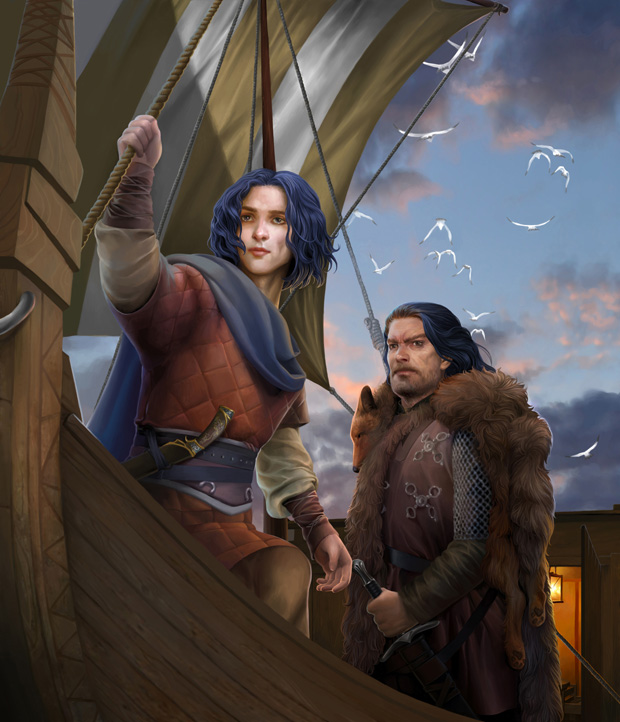
The prince wore sword and dagger, black boots polished to a high sheen, a black cloak lined with blood-red silk. With his hair washed and cut and freshly dyed a deep, dark blue, his eyes looked blue as well. At his throat he wore three huge square-cut rubies on a chain of black iron, a gift from Magister Illyrio. Red and black. Dragon colors. That was good. “You look a proper prince,” he told the boy. “Your father would be proud if he could see you.” Young Griff ran his fingers through his hair. “I am sick of this blue dye. We should have washed it out.” “Soon enough.” Griff would be glad to go back to his own true colors too, though his once red hair had gone to grey. He clapped the lad on the shoulder. “Shall we go? Your army awaits your coming.” – The Lost Lord, ADwD
Again, as far as I can tell the colour blue is serving a practical purpose and, more significantly, we see that Young Griff has no sentimental attachment to the dying of his hair nor the colour blue – he is, in fact, sick of it. If the colour blue really was important to him and symbolic of his character, why not have him also wear something else blue alongside the overt red and black Targaryen colours or the rubies associated with Rhaegar’s armour? Like… a blue flower, maybe? For this reason, I doubt the colour blue is all that significant to Aegon nor does it genuinely have anything to do with his mother. Ultimately, even he knows that blue dye is a means to an end; a disguise, a glamour, and a mummery he is looking forward to dropping.
Conclusion
The association with ‘the colour blue’ does not wholly work as a textual allusion, either. The reason I underlined flower above is that I would disagree that Lyanna Stark is associated with the colour blue by itself. It is winter roses that have become symbolic of her (and arguably “stolen” daughters of Winterfell). One of the first things we learn about her from Ned Stark is that she was “fond of flowers” (Eddard I, A Game of Thrones ‘AGoT’). He recalls her being “in a room that smelled of blood and roses” when he makes her promise to her and she is clutching dead rose petals (Eddard I, AGoT) and then later during his fever dream sees “A storm of rose petals… across a blood-streaked sky, as blue as the eyes of death” (Eddard X, AGoT). The allusion is floral/roses rather than colour based and the “blue as the eyes of death” makes one think of the blue star eyes of the Others and their Wights
Winter roses are described as “pale blue” as well as “blue as frost” in Eddard’s thoughts (Eddard XII and XV, AGoT) and even in Ygritte’s telling of Bael the Bard to Jon (Jon VI, A Clash of Kings ‘ACoK’) – there is an association is the colour of frost and ice. If we try to line this up with Aegon’s hair dye, the hue does not match. Aegon’s dyed hair is described as “a shock of dark blue” (Tyrion III, ADwD) and “a deep, dark blue” (The Lost Lord, ADwD). So, it lacks a distinct textual echo. In other words, when I hear that Aegon’s colour is blue – a dark blue – I do not think of frost, ice, winter roses and certainly not Lyanna.
Furthermore, later another poster pointed out the final nail in the Blue = Lyanna idea over it simply being a floral allusion. Essentially, it noted that Brienne is the character in the series most associated with the colour blue. Again, I went back to check and lo and behold, that was something that could be corroborated.
If we were to associate any character with ‘the colour blue’, it would be Brienne of Tarth. It connects to her on several levels: when she first appears she is “the blue knight” — dressed in cobalt blue armour, steel and even her morningstar is blue. Catelyn’s chapters even describe her as “Brienne the Blue” (Catelyn II and IV, ACoK); she hails from Tarth, “the Sapphire Isle” named for the blue of its waters; her only truly beautiful feature is her “large and very blue” eyes, as “blue as her armour”, and she wears a blue dress that brings out the colour of those eyes.
Based on all of this, it is hard for me to really accept that there is a distinct and meaningful parallel between Lyanna and Aegon simply based on ‘the colour blue’. I think that ‘Order of the Green Hand’ are 100% wrong on this one and might be motivated more by a desire to find an alternative to R+L=J to work with their N+A=D theory.
Sadly, I don’t think it holds up under a second passing thought.
 Scarlettpeony Writes